Picking the best crypto exchange low fees US traders can actually use comes down to one uncomfortable truth: the “0% fees” banner on most homepages rarely tells the whole story. The core point of this article is that spread, withdrawal costs, and instant-buy markups usually matter more than the headline maker/taker percentage, and the platforms that win on total cost aren’t always the ones that advertise loudest. Below, you’ll get a straight comparison of the exchanges that consistently post the lowest real-world costs in 2026, how their fee structures actually work, and how to avoid the markup traps that eat into new traders’ balances before they even place a second trade.
How Crypto Exchange Fees Actually Work
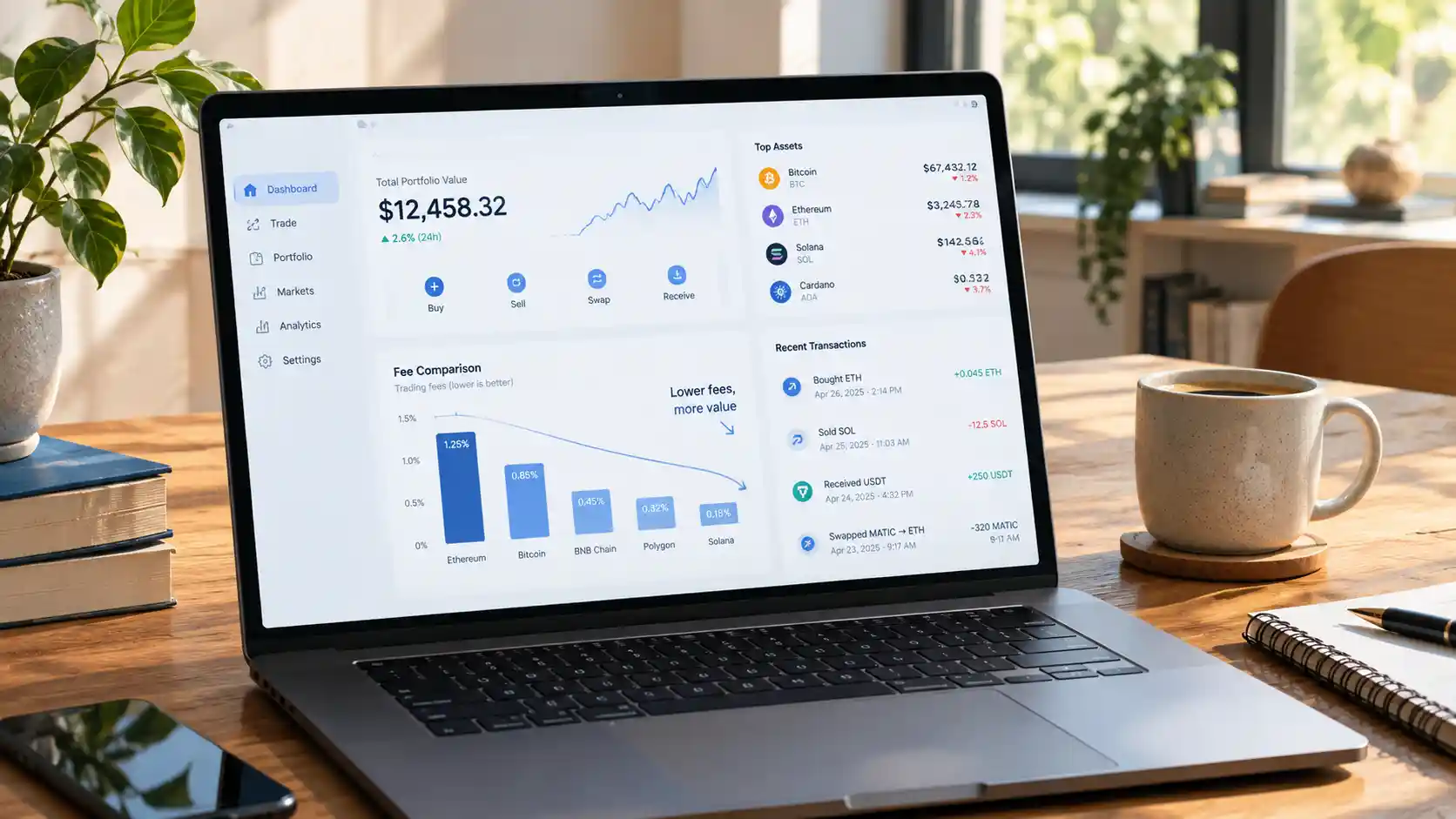
Every exchange charges fees in layers, and understanding those layers is the only way to compare platforms fairly. There’s the trading fee itself, usually split into a maker rate (for orders that add liquidity, like limit orders) and a taker rate (for orders that remove it, like market orders). Then there’s the spread, a markup baked into the buy/sell price that many exchanges don’t disclose as clearly as the trading fee. Finally, there are withdrawal and network fees, which vary by asset and can quietly become the largest cost for anyone moving funds off-platform regularly.
What’s the Difference Between Maker and Taker Fees?
A maker fee applies when your order adds liquidity to the order book, while a taker fee applies when it removes liquidity by matching an existing order instantly. Limit orders that sit unfilled for a while are usually maker orders, and they almost always cost less than taker orders, since exchanges want to reward traders who help fill out the order book rather than penalize them. On OKX, for example, published rates run as low as 0.08% maker versus 0.10% taker at the base tier, a gap that adds up fast for high-frequency traders.
Why Do Beginner-Friendly Apps Often Cost More?
Beginner-friendly buy/sell interfaces almost always cost more than advanced trading terminals on the same exchange, because the convenience comes wrapped in a spread. Coinbase’s basic instant buy/sell feature, for instance, has carried fees up to roughly 3.99% in recent published rate cards, while its advanced trading interface runs a maker/taker model closer to institutional pricing once volume increases. If you’re a new trader dipping a toe in with $100, that gap probably doesn’t matter much. If you’re moving thousands of dollars a month, it’s the difference between a hobby and a real cost center.
Comparing the Lowest-Fee Exchanges for US Traders
Not every low-fee exchange operates cleanly in the US market, so it’s worth separating “cheapest globally” from “cheapest and fully available to US residents.” Kraken, Coinbase Advanced Trade, and Gemini remain the most consistently US-compliant options with transparent fee schedules, while exchanges like OKX and MEXC offer lower headline rates but come with varying levels of US state restrictions that traders need to check directly before funding an account. This is exactly the kind of detail that separates a genuinely useful comparison from a marketing page availability restrictions change by state and by month, so always confirm current access on the exchange’s own compliance page before committing funds.
Which Exchange Has the Lowest Fees for US Traders?
Among platforms with confirmed, broad US access, Kraken Pro and Coinbase Advanced Trade currently post some of the most competitive maker/taker schedules, with top-tier volume traders paying a fraction of what retail app users pay. Kraken Pro’s published fee schedule scales down toward institutional-level pricing as 30-day volume climbs, and it discloses those tiers openly rather than burying them in a support article. Gemini flips the usual pattern at the very top of its volume tiers, where its highest-volume rate can actually undercut both, though that tier applies to institutional-scale trading most individual traders will never reach.
Is a Lower Headline Fee Always the Better Deal?
No a lower headline fee only helps if the exchange also has a tight spread and low withdrawal costs, since a “0% trading fee” claim can still leave you paying more overall through a wider buy/sell spread. This is the single most common trap for new traders: an exchange advertises free trades, and the true cost simply moves into the price you’re quoted rather than a line-item fee. Before trusting a “no fees” claim, place a small test trade and compare the executed price against the live market price on a tracker like CoinMarketCap; the gap tells you the real spread cost in seconds.
What US Traders Should Know Before Choosing an Exchange
Cost isn’t the only factor that should drive your decision, even if it’s the one most comparison articles focus on hardest. Regulatory standing matters enormously in the US, since exchanges operate under a patchwork of state money-transmitter licenses, and a platform can be legally available in Texas but blocked in New York. Security track record, insurance on custodial holdings, and how fast withdrawals actually process in practice are all things that only show up after you’ve used a platform for a few months not something a fee comparison alone will tell you.
Do Trading Fees Matter More Than Security for Most Traders?
For most casual traders, security and reliable access matter more day-to-day than shaving a fraction of a percent off trading fees. A 0.1% difference in fees on a $500 trade is $0.50; a platform freezing withdrawals during a volatile week, or suffering a breach, can cost far more than any fee savings ever would. That said, active traders moving large volumes weekly should absolutely prioritize the fee schedule, since those fractions of a percent compound meaningfully at scale it’s a genuine trade-off between the two trader profiles, not a universal rule.
How Can You Actually Lower Your Trading Fees?
You can lower your effective trading fees by using limit orders instead of market orders, holding an exchange’s native token where fee discounts apply, and consolidating volume onto one platform to reach lower-fee tiers faster. Several exchanges, including Binance and MEXC, offer meaningful taker-fee discounts often in the 10-20% range for traders who pay fees using the platform’s own token, which is worth calculating against the token’s price volatility before committing.
Conclusion
There’s no single universal answer to which exchange has the lowest fees, because “lowest” depends on your trading style, your volume, and which platform is actually licensed to operate where you live. What matters more than chasing the cheapest headline number is understanding the full fee stack trading fee, spread, and withdrawal cost and testing a platform with a small trade before committing serious capital. Kraken, Coinbase Advanced Trade, and Gemini remain the steadiest, most transparent options for US-based traders as of 2026, with genuinely lower advanced-tier fees for anyone willing to move past the beginner app.
Frequently Asked Questions
What is the cheapest crypto exchange for US traders in 2026? Kraken Pro and Coinbase Advanced Trade currently offer some of the most competitive, fully transparent fee schedules for US-based traders, especially once you move past the beginner buy/sell app to the advanced trading interface.
Do US crypto exchanges charge withdrawal fees? Yes, most US-compliant exchanges charge a network fee when you withdraw crypto to an external wallet, and that fee varies by asset since it reflects the underlying blockchain’s transaction cost, not just the exchange’s own pricing.
Is it cheaper to buy crypto with a bank transfer or a card? Bank transfers (ACH or wire) are almost always cheaper than debit or credit card purchases, since card payments typically carry an extra processing fee on top of the exchange’s standard trading fee.
Can I avoid crypto trading fees entirely? You can’t avoid fees entirely on centralized exchanges, but you can minimize them by using limit orders, trading in higher volume tiers, and paying fees with a platform’s native discount token where available.